Sunday, April 17, 2011

My Thoughts on Vonnegut's Writing Style and Slaughterhouse 5

We’re basically at the end of the Slaughterhouse 5 unit, so I thought I’d make a reflection post, talking about what I thought about Vonnegut’s writing style and Slaughterhouse 5 as a whole. To start things off, I loved Vonnegut’s unique writing style, and it's like nothing I've ever read before. His voice as a writer is so personal and casual in his narration of the story, and it really hooks you in, completely immersing you into the crazy that is Vonnegut's mind. Reading the novel, I really felt that I was time travelling side by side with Billy Pilgrim.What I really liked about Vonnegut, was his very simple way of writing things. He didn't spruce things up with big words, and he certainly doesn't use fancy punctuation like semicolons, which is proven with his quote:


"Here is a lesson in creative writing. First rule: Do not use semicolons. They are transvestite hermaphrodites representing absolutely nothing. All they do is show you've been to college."
. 
Slaughterhouse 5 was confusing at times, but Vonnegut wrote everything in a way that you could read a sentence and completely understand it the first time. Vonnegut also doesn't write in a way where he puts a lot of fluff in his writing. And that’s why I like Vonnegut. His writing is simple and to the point, and he writes it so that anybody from any walk of life could pick up his book and read it cover to cover and understand the story completely (well, as much somebody can understand Slaughterhouse).
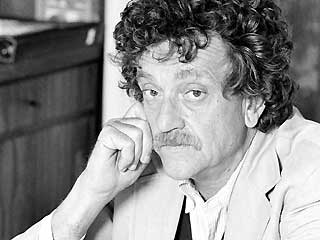
I also like how Vonnegut uses exaggeration and the contrasting of images to both describe things and prove a point. An excellent example of this is how Vonnegut describes Dresden. He describes pre-firebombed Dresden as Oz, obviously relating to the Emerald City, from the book The Wizard of Oz. This image is put into your head, and then when you find out about what Dresden post-firebombing looks like, it increases that second image ten fold, because the contrasting of those two ideas make it look that much worse. 


The nonlinear storyline and the way Vonnegut notifies the audience of what's going to happen in the book before it happens really gives the reader a different experience. Never before have I read a book and had the storyline spoiled by the author of the book. It

Reflecting on Slaughterhouse 5, I really enjoyed it. When we started a couple of months ago, I wasn’t really into it. I started reading the first couple pages, but I’d only get through a couple of pages and then I’d find myself putting it down. A week later I was being driven to a “Free Libya” protest in Toronto, and there was nothing else to do in the car, so I brought Slaughterhouse 5 with me. It was a 4 hour drive there and a 4 hour drive back, and in that time period I got from like page 1 to page 154. I couldn’t put it down! The nonlinear storyline and the way Vonnegut notifies the audience of what's going to happen in the book before it happens really gives the reader a different experience. Never before have I read a book and had the storyline spoiled by the author of the book. The time travelling always made you almost subconsciously readjust ever time Billy Pilgrim jumped to the future or past.


The many characters of the book (primary or secondary) were all so intriguing, and really meshed together well. They were realistic, and I would be hardpressed to see anybody not find a character to root for. The main character, Billy Pilgrim, really had nobody rooting for him, including me. This is the first book where I actually didn't like the main character at all. In Brave New World, I didn't like Bernard. But at least Aldous Huxley switches main characters to John, and you can root for him. But in Slaughterhouse 5, it's just Billy Pilgrim. He is the most unlikable and pathetic character I've ever come across as a main character, but somehow, he makes the novel enjoyable with all of the situations he goes through.Which leads me to my next point: Vonnegut's humor. I really have a problem with laughing at Pilgrim and the situations he's thrown into. Sure, it's a bit dark at times, but Vonnegut always makes it funny, without going [too] over the top. I still remember literally laughing out loud when Vonnegut was describing how the champagne was flat, and he wrote “so it goes”.  


When I got to the end of the book, and I read the last phrase “Poo-tee-weet?”, I was shocked. After all the time travelling with Pilgrim and Vonnegut, it was finally done. And I'll be honest, I was disappointed in the ending of the book. And a bit angry. I know, I know... Vonnegut prides himself in his anti-climatic endings and everything, but COME ON! It was the end of the book! It wasn't even really an ending. It’s like Vonnegut just said “Aww forget it. It’s been like 20 years in the making, I’m not spending any more time on it”.  I didn't expect something huge to happen at the end (although I thought that Vonnegut could've spent a little bit more time on Dresden then he did), but I at least thought that Vonnegut would've written some deep meaning at the end or at the very least given the reader a bit of closure! It’s a bit sad to see a masterpiece like this kind of end on a bad note like that, but I guess that’s just Vonnegut’s style.

Finishing Slaughterhouse 5, I think I’ve really found an author I like. I’ve searched up a bunch of interviews of him on the internet, and he’s a really fascinating character. And that's probably why I like him so much as a writer. In Slaughterhouse 5 he “more or less” describes everything how he saw it. He was there during the firebombing of Dresden, he served in the war and survived, and at the end of it all, ended up writing a book about it. Because he lived through most of what he wrote, it makes the entire book that much more realistic and hooking to the reader. I’ll probably pick up some more of his work, like Cat’s Cradle for a bit of “free time” reading.

Saturday, April 16, 2011

Slaughterhouse Five: The Movie

A couple weeks ago (I think) we watched the Slaughterhouse 5 movie trailer in class. Mr. Lynn didn’t really know if it was professionally made or just fan made, but I don’t really think it matters. Amateur or professional, this movie looks like it sucks the big one. I couldn’t believe what I was watching. A book SO GOOD could have a movie SO BAD. I even gave it a second chance afterwards. I said “Well it’s not really fair if I judge the entire movie just by the trailer”, so I tried watching it. I got about15 minutes in and I turned it off. It was that bad. But why is that? Slaughterhouse 5 has all the makings of a good movie! It has action, good characters a solid story... so why the upset? Well, I did a bit of research on the film, and I think I understand why it was so bad. The film was released in 1972, roughly three years after the book debuted. My theory is that the people behind the creation of the movie probably weren't trying to cater to the fans or try and do justice to the book. It was most likely made just for the sake of making money off of something that was very popular at the time. Vonnegut probably didn't even have any creative control over the movie. He probably just signed it off thinking that they'd do a good job on it. And from what I've seen in interviews with him, if he had known how bad it was going to be, he would have definitely spoken up, and the movie probably would have been a hundred times better then it was.


I’m bashing the movie a lot, but I actually think that Slaughterhouse 5 has MASSIVE potential to be a good movie. With the right team of directors, special effects people and writers this would be an awesome movie! I definitely have some ideas on how the movie should be made. First off: transitions. That's basically what Slaughterhouse 5 is. It's just a bunch of transitions, where Billy Pilgrim is jumping from different periods in his life. The possibilities are endless with this, and should be properly utilized. Billy Pilgrim could go to sleep, and wake up in another time period. He could dive into a pool, resurface and find himself in swampy water in World War II. He could be in a fox hole with Roland Weary, a shot goes off, Billy winces, and then he finds himself opening his eyes to him sitting infront of a TV watching a war movie being replayed backwards. Another thing that should be focused on is music. Music would be an important role in the movie because not only is Pilgrim time traveling to different times, he's ending up in different places and situations as well. I think that the music should change accordingly to better fit the mood. In the war situations there should be more heavier music, like heavy metal. For the more peaceful situations like when he's lying down in the hospital with Eliot Rosewater, there could be like violin or something. In the Tralfamadorian space ship and when Pilgrim is on Tralfamadore there could be more of a space-ish sci-fi kind of sound, like the theme from X-Files. Special effects would also have to be an area of focus, because there's a lot in the book that the film would need to cater to as far as CGI goes. Instances where Pilgrim is in the war or when he's being abducted and brought to Tralfamadore would need very good special effects to make the film believable and not hokey. Lastly, the writing. The Slaughterhouse 5 movie would need a team of very skilled writers to do justice to the book. The writers would need to make the characters and plot flow like Vonnegut, and mimicking his greatness would probably be the hardest thing to do.


Think back to a week ago in our English class. Mr. Lynn told us to split into groups and create a storyboard for a trailer of a Slaughterhouse 5 movie. In less then 38 minutes, we cranked out a lot of  great ideas. I know it's only a trailer, and making a film is more difficult then just making a 30 second to 2 minute long trailer, but think about it. If that's what a class of eleventh graders could do in less then 38 minutes, imagine what a team of professional film makers could do? It would be amazing! 


If Slaughterhouse Five: The Movie hit theaters today, I wouldn't hesitate to buy a ticket. It has all the right ingredients for a blockbuster film. The only problem is, it would be extremely hard for the movie to do justice to the book and would probably require a massive budget. But hopefully one day, it does get remade. And hopefully this time, it's not screwed up.

Mr. Rager vs. Slaughterhouse Five


"Mr. Rager" Lyrics:
I'm off on a adventure... (we're good) 
"This here is dedicated to all of the kids like me"
I'm on my way to heaven
"Wherever you are...Now"

Birds seen flying around, you never see them too long on the ground
You want to be one of them...(yeaah) x2
You might hear the birds singing flying around, you never see them too long on the ground
You want to be one of them...(yeaah) x2

[Chorus)
Woah Now, HEY!, Mr.Raaager, Mr.Rager
Tell me where you're going, Tell us where you're headed
I'm off on a adventure, Mr. Raaager
Tell me some of your stories, Tell us of your travels
HEY!, Mr.Raaager, Mr.Rager
Tell me where you're going, Tell us where you're headed
I'm on my way to heaven, Mr. Raaager
Can we tag along, Can we take the journey

Knocked down round for round
You're feeling like you're shot down on the ground
When will the fantasy end, When will the heaven begin (yeaah)
You might be knocked down round for round
You're feeling like you're shot down on the ground
When will the fantasy end (yeaah), When will the heaven begin (yeaah)

[Chorus] x2
Woah Now, HEY!, Mr.Raaager, Mr.Rager
Tell me where you're going, Tell us where you're headed
I'm off on a adventure, Mr. Raaager
Tell us some of your stories, Tell us of your travels
HEY!, Mr.Raager, Mr.Rager 
Tell me where you're going, Tell us where you're headed
I'm on my way to heaven, Mr. Raaager
Can we tag along, Can we take the journey

HEY! Mr. Raaaaaaager
HEY! Mr. Raaaaaaager (I'm on my way to heaven)
HEY! Mr. Raaaaaaager
HEY!


I don’t know if I’ve just been listening to Cudi too much, but every time I listen to the song “Mr. Rager” I think of Billy Pilgrim from Slaughterhouse 5. I interpret the song as a guy named Mr. Rager who is always angry and frustrated (raging, hence the name) and he wants to be like a bird to just fly away and escape his troubles. He finally attempts to escape his troubles by “going on a adventure” where maybe he can find inner peace. When listening to the song I found that if you compare Kid Cudi’s Billy Pilgrim and Kurt Vonnegut’s Mr. Rager, they are a lot alike. At the beginning of the song it says:

Birds seen flying around, you never see them too long on the ground
You want to be one of them...(yeaah) x2
You might hear the birds singing flying around, you never see them too long on the ground
You want to be one of them...(yeaah) x2 

Billy Pilgrim looks at the birds singing (“Poo-tee-weet?”) and wishes he could be as free and uncaring as them. Seeing them singing and flying around, he wishes he could do the same, but he knows he can’t because, by time travelling, he knows that fate is completely predetermined. I see the birds in the song as a symbol of freedom, maybe implying freewill.

The chorus of the song is sang by Billy Pilgrim and everyone that believed and supported him when he claimed that he could time travel and that he was abducted by aliens. They are asking him things like Where he’s headed or asking “Tell us some of your stories?”. Only his supporters believe him, and everybody else calls him crazy.

The second part of the song goes:

Knocked down round for round
You're feeling like you're shot down on the ground
When will the fantasy end, When will the heaven begin (yeaah)
You might be knocked down round for round
You're feeling like you're shot down on the ground
When will the fantasy end (yeaah), When will the heaven begin (yeaah)
 

This is basically describing Billy’s life. He’s always depressed, and is kind of pathetic. He’s always feeling down because he’s kind of an existentialist. Only living for the sake of living, because he already knows what’s going to happen. He asks himself “when will the fantasy end” and “when will the heaven begin?”. The “fantasy” is Billy Pilgrim’s life, and the “heaven” is his death and the repeat of his life.

At the end, the song repeats “Mr. Raaaaaaaaaager”. I compare this to the end when Billy Pilgrim talking about when, where and how his death will take place. I see the repeating of “Mr. Raaaaager” as the Billy’s supporters chanting his name in protest, because they don’t want him to die. At the end he says “I’m on my way to heaven” meaning after he gets assassinated by Lazaro’s hitman, he’ll just repeat his life again.

I also made the connection that both Mr. Rager and Billy Pilgrim are sort of alter egos of their writers. Although Kurt Vonnegut is in the story of Slaughterhouse 5 as an actual character, I think that Vonnegut’s experiences are kind of told through Billy Pilgrim, and not himself. Mr. Rager, is one of Kid Cudi’s many alter egos, representing his angry and frustrated side.

Alternate Blog Topic: Multiculturalism > COMPLETE Assimilation.

I'm subbing Assignment #4 for this one.


I don’t think that Vonnegut particularly sympathized with the German people. I think he certainly showed Germans in a better light, at a time where they usually aren't, like when that blind German innkeeper  on page 181 let the American soldiers stay in his barn while giving them soup, coffee and beer. But, I don't think he intentionally tried to sympathize with the German people.  I think he (like always) just wrote it how it was, and how he saw it. People at that time, and still today, would say “All German soldiers in World War II were bad”. And yes, it can be argued that a lot of them had a couple screws loose. The atrocity that was the Holocaust will probably never be forgotten, and shouldn’t be forgotten. But saying that every German soldier was bad is over generalizing to the max. They were just like any other soldier at that time. Why do you think that soldiers try to never give the enemy a face? Because they don't want the soldiers to think about what they are ending once they pull that trigger. But I think that’s exactly what Vonnegut did in Slaughterhouse 5. He gave the enemy a face, and showed that not only were the German soldiers not that different from any other, but the German people weren't as well.

I don’t think that complete assimilation or cultural conformity is ever justifiable, unless it is of your own free will. I think that everybody should be proud of where they come from, and anybody has the right to flaunt it. I’m not saying completely shut out your new country’s traditions and customs. You should embrace those too, just don’t conform completely.

As far as the Vonnegut family's complete assimilation goes, I don’t really think they had much of a choice. It would probably have been in the Vonnegut’s family’s best interest to keep their German heritage to themselves anyways, because if they did come out and embrace their culture at that time they would have probably gotten a lot of trouble for it. Think about it. If your son went out to war, and he was killed in the war by a German, wouldn’t you blame the Germans for it? Maybe you could, because a German probably did kill him. But the German side and their side are basically the same. They’re fighting for their country. I don’t think anybody wakes up in the morning saying “Oh goodie, I get to kill more people today”. They didn’t really have much of a choice, much like how Vonnegut’s family probably didn’t have a choice in hiding their German roots.

I can’t even picture what it must have been for Vonnegut and his family at that time. Just imagine, you’re German, and your country is fighting against Germany! It’s like doublethink from 1984- “Fight against Germany to protect your home and your culture”… but technically Germany was your home first and your culture is the one you’re fighting against? Doesn’t really make much sense… but then again, war is nonsensical.

Friday, April 15, 2011

Assignment #5: Sorry Readers, No Life Lesson For You.

This is for all of you Seinfeld fans reading this post.
I've read a couple of other people's posts to see what they would write about if they were going to write a book, and I found that a lot of them had these deep morals. I don’t know if it was just how Assignment #5 was worded, or if everyone's posts that I read had morals to them, but for me, I probably wouldn’t write a story with any meaning at all. I just don’t see myself that deep, and I don't really feel as if I have any life lessons to share. If I were to be an author, I’d probably just write a book that means nothing. Just a book that would be fun to read, maybe like an action or comedy. The story of my book would probably be really cliché, where it is a storyline that has probably been seen by a lot of people before. The main character would probably be a normal teenager, who is thrust into an abnormal situation. There would be lots of obstacles for the main character to overcome. He’d meet people along the story that he liked and didn't like. He’d probably fight bad guys, and at the beginning of every fight appear to be losing. But just when the reader thinks he’s done for, he makes a comeback and wins (everybody loves an underdog). At the end, he’d probably face off against some kind of main villain, and win. I would try and make the story fun and exciting to read, and I would probably write the story in a nonlinear fashion like Vonnegut, where the story is kind of all over the place. I would try and make the book a "page turner", where the reader wants to read on and on and on. I'd try and make the book as exciting as I could, but I just don't see myself trying to enforce a message or a lesson onto people.

Wednesday, April 13, 2011

Assignment #3: Censorship S*cks.

As far as literature goes, I do not think that censorship should be allowed. A lot of the books we’ve read this year have been controversial titles, and most of it was because people just didn’t agree with the message or they didn’t like some of the more risqué material. In my opinion, I think that a book that generates talk or “controversy” for whatever reason is a good book. This usually means that they are interesting if they get a response, and this can be proven with the books we’ve read this year. Surprisingly, I haven’t met a novel assigned that I haven’t liked. Were they shocking? Yes. Should they be banned because of their shock value? No. Because of their “controversial” themes I actually found them more interesting.

Vonnegut’s Slaughterhouse 5 gained controversy because of “sexual themes, profane language and how he depicted war/military. Well, I don’t know what it was like 40 years ago, but I was definitely not shocked about any of the content in the book. I don’t know if it was because I read Brave New World first or because I was just used to hearing profane language, but I found it completely fine. I know that when I walk down the hallways or go out for lunch people drop the F-Bomb like mad. And I’m sure anybody has sworn at least once and probably heard it from other people twice as much. Yet when this “profane language” is written down in a book for people to read, alarms go off. I think that this both takes away from the realism of a book and stifles the author’s creativity.

As for Slaughterhouse 5 being censored and banned in places, I don’t support that at all. Like Kurt Vonnegut said, “All this happened, more or less. The war parts, anyway, are pretty much true”. The book talks about the firebombing of Dresden and the military during World War II, and it was censored because of “sexual themes and profane language”. Vonnegut wrote the truth, and followed his 7th rule when writing fiction; “Write to please just one person”. He wrote to please himself. He depicted the idea of war in a very unglorifying light (if that’s even a word), at the time when people were glorifying war like crazy, trying to get recruits for Vietnam. If you censor Slaughterhouse 5, then you should censor any history book that contains information about the second world war, because Vonnegut wrote about WW2 “more or less” how he saw it. 

Tuesday, April 12, 2011

Assignment #2: The Crusade Against Hot Fudge Sundaes and Their Controversial Messages.

"Any reviewer who expresses rage and loathing for a novel is preposterous. He or she is like a person who has put on full armor and attacked a hot fudge sundae."
 -Kurt Vonnegut


Kurt Vonnegut's book Slaughterhouse 5 was surrounded with controversy by many people who hated it for whatever reason they had (ie. sexual themes, profane language). People challenged the book and I'm pretty sure it was banned in some places, all because  people didn't like the messages and themes of the book.  I think that the controversy that his book generated, was the inspiration for this quote. This quote to me, is just classic Vonnegut. He compares two things that wouldn't usually be compared with each other, splashes a bit of overexaggeration and at the end of it all, makes the quote make sense to the reader. My interpretation of the quote is this: Vonnegut is comparing books with hot fudge sundaes. Hot fudge sundaes, like books, are meant to be a good thing. The whole purpose of you even choosing to indulge in a hot fudge sundae or book, is for you to enjoy it. If you don't like the taste of a hot fudge sundae you aren't going to make picket signs and strike, saying that the sundae's "message and themes" aren't appropriate for today's world. You might complain a bit about the taste, but ultimately you won't make a big deal out of the experience. Same with books. If you don't like a book, you shouldn't rage at it and put it down because you don't like it's messages or themes. Just put it down if you don't like it.


Now, if I said that I've never raged at a book before, I'd be a hypocrite. I've fought my fair share of hot fudge sundaes (especially last year *cough* MAYOR OF CASTERBRIDGE *cough*). Then again I didn't really have much of a choice because it was my class' assigned book at the time, and I probably would have failed if I hadn't read it. But believe me, if I did have the choice, I would have definitely taken Vonnegut's advice and put it down.There's no use in fighting against something that doesn't fight back.